

Project EMBER
Project EMBER: is SPEmet’s research and product initiative examining how fraud progresses before extraction.
The initiative focuses on the intersection of fraud, trust, manipulation, synthetic presence, and AI-enabled influence.
That work has led to EMBERTRACE: a patent-pending pre-extraction intelligence system designed to identify behavioral progression, manipulated intent, synthetic trust, and the path from trust to compliance before financial loss, access compromise, or harmful user action occurs.
It is not a single-message scam detector, email scanner, or replacement for identity verification.
It is a pre-extraction intelligence layer focused on behavioral progression across channels where trust, pressure, dependency, synthetic presence, and action-readiness may be forming.
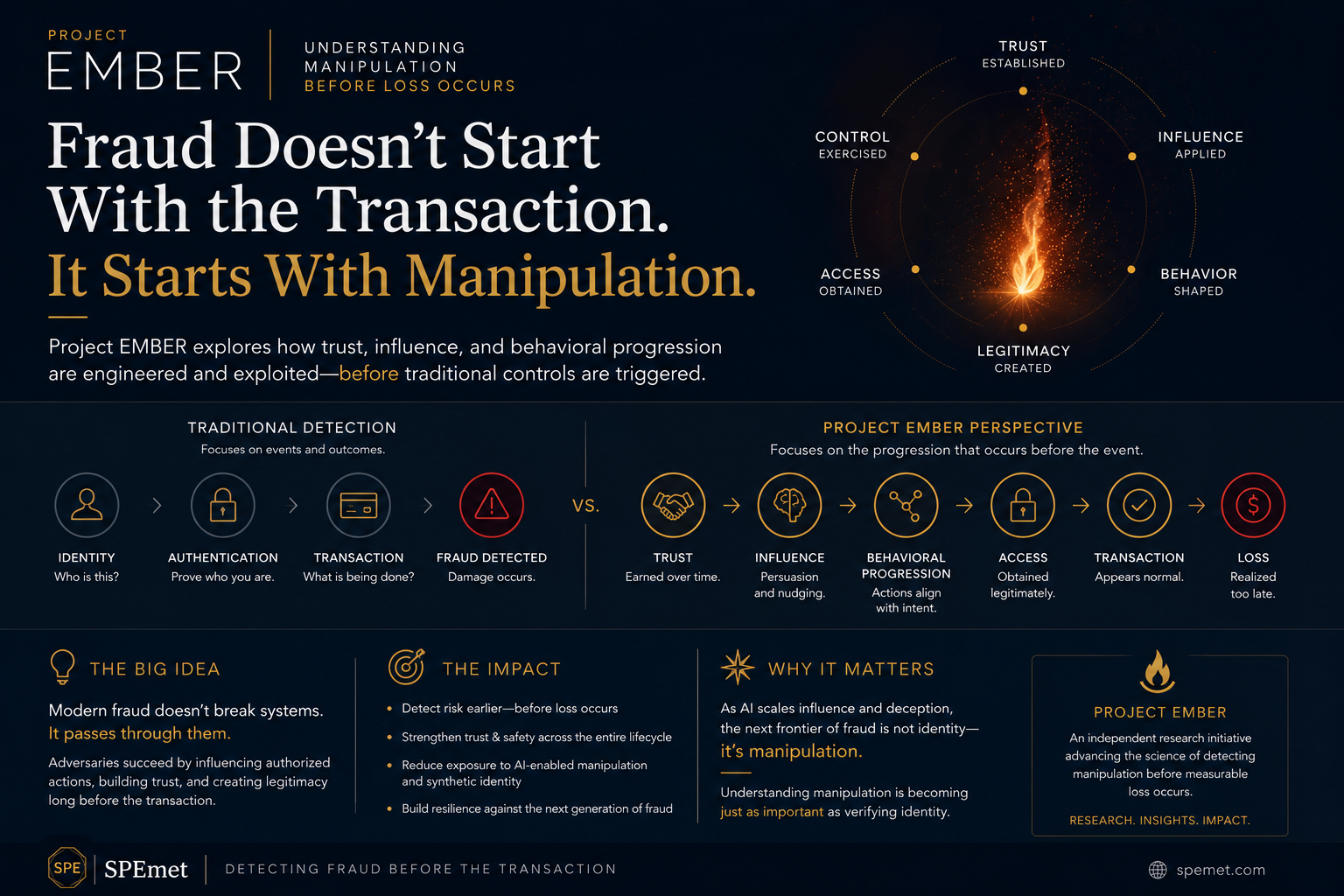
What Is Project EMBER?
Project EMBER is an independent research initiative exploring how trust, influence, and behavioral progression evolve in an era of AI-enabled fraud.
Traditional fraud programs focus on outcomes.
Project EMBER focuses on the progression that occurs before those outcomes become visible.
The Core Observation
Most fraud detection systems are designed to identify unauthorized activity.
Increasingly, adversaries succeed by influencing authorized activity.
The compromise often occurs long before the transaction.
Why This Matters
As AI increases the scale of persuasion, deception, and relationship-building, understanding manipulation may become as important as understanding identity.
Identity explains who someone claims to be.
Trust explains what we are willing to do because of it.
The Trust Provenance Hypothesis
Most fraud prevention systems focus on verifying identity.
Project EMBER explores a different question:
Can trust be measured with the same rigor that identity is verified?
If trust has an observable origin, development, and progression, manipulation may become detectable before traditional fraud signals appear.
Is manipulation becoming the primary attack vector?
As identity verification improves, adversaries increasingly succeed by influencing legitimate users rather than impersonating illegitimate ones.
Can behavioral progression predict fraud?
Project EMBER explores whether the earliest indicators of fraud appear long before transactions, accounts, or losses become visible.
Is AI making persuasion infinitely scalable?
For the first time, trust-building, influence, and deception can be generated and personalized at industrial scale.
Current Areas of Research
Trust exploitation
Behavioral progression
Synthetic identities
AI-enabled manipulation
Trust provenance
Adversarial systems
From Project EMBER to EMBERTRACE
SPEmet’s research has led to EMBERTRACE, SPEmet’s patent-pending product system for pre-extraction intelligence.
EMBERTRACE is designed to evaluate whether a conversation, relationship, identity, or interaction is progressing toward manipulation before financial loss, access compromise, or harmful user action occurs.
It is not a single-message scam detector, email scanner, or replacement for identity verification.
It is a pre-extraction intelligence layer focused on behavioral progression across channels where trust, pressure, dependency, synthetic presence, and action-readiness may be forming.