

Detect the trajectory before the transaction.
EmberTrace is a pre-extraction intelligence system designed to identify how weak behavioral signals, trust formation and manipulation progress toward consequential action.
Traditional fraud systems become most certain when time is running out.
Authentication, transaction monitoring and post-event investigation remain essential. But many modern fraud events begin much earlier, while trust is being established, pressure is developing and intent is being manipulated.
Weak Signals
Individual behaviors may appear harmless when viewed in isolation. EmberTrace looks for the meaning created when those signals begin to accumulate.
Progression
Risk changes as behavior persists, relationships deepen, urgency increases and actions begin moving toward a consequential outcome.
Intervention
The objective is not simply better detection. It is creating actionable lead time while an organization still has options to change the outcome.
Fraud becomes visible before it becomes financial.
EmberTrace follows progression across the developing relationship rather than treating each event as an isolated moment.
Initial Contact
An influence, relationship or adversarial interaction begins. Individual indicators may still appear benign.
Trust Formation
Credibility, familiarity or dependency begins developing across continued interaction.
Manipulation
Pressure, isolation, urgency or persuasive control begins altering the target's decision environment.
Action Preparation
Behavior begins progressing toward a financial, credential or access-related decision.
Extraction
Money, credentials, access or another adversarial objective is sought or transferred.
From trajectory theory to operational intelligence.
EmberTrace is SPEmet’s pre-extraction intelligence system, developed to evaluate whether interactions are progressing toward manipulation before financial loss, access compromise or another harmful action occurs.
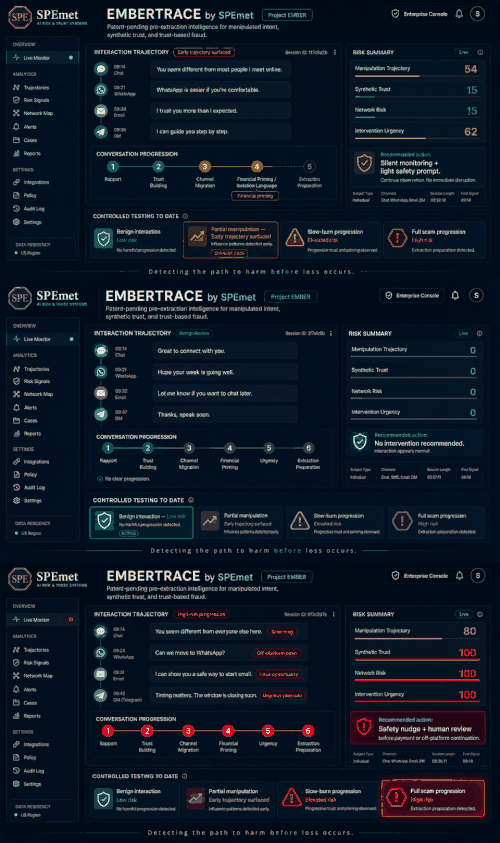
EmberTrace is designed to answer a different question: not simply “Is this event fraudulent?” but “Is this interaction progressing toward harm?”
The signal is not always one event. It is the relationship between events.
Persistence
Which signals continue rather than disappear?
Velocity
How quickly is the interaction progressing toward harm?
Context
What does the same behavior mean within the wider trajectory?
Stage
Where is the developing interaction on the path toward extraction?
The question is not only whether fraud was detected.
A useful early-warning system must demonstrate that it creates meaningful time to intervene without creating unsustainable operational burden.
“The most useful fraud question may not be ‘Did we detect it?’ but ‘How early could we have known?’”
Explore what earlier detection could look like.
Talk to SPEmet about an EmberTrace pilot, historical trajectory assessment or potential use case.